
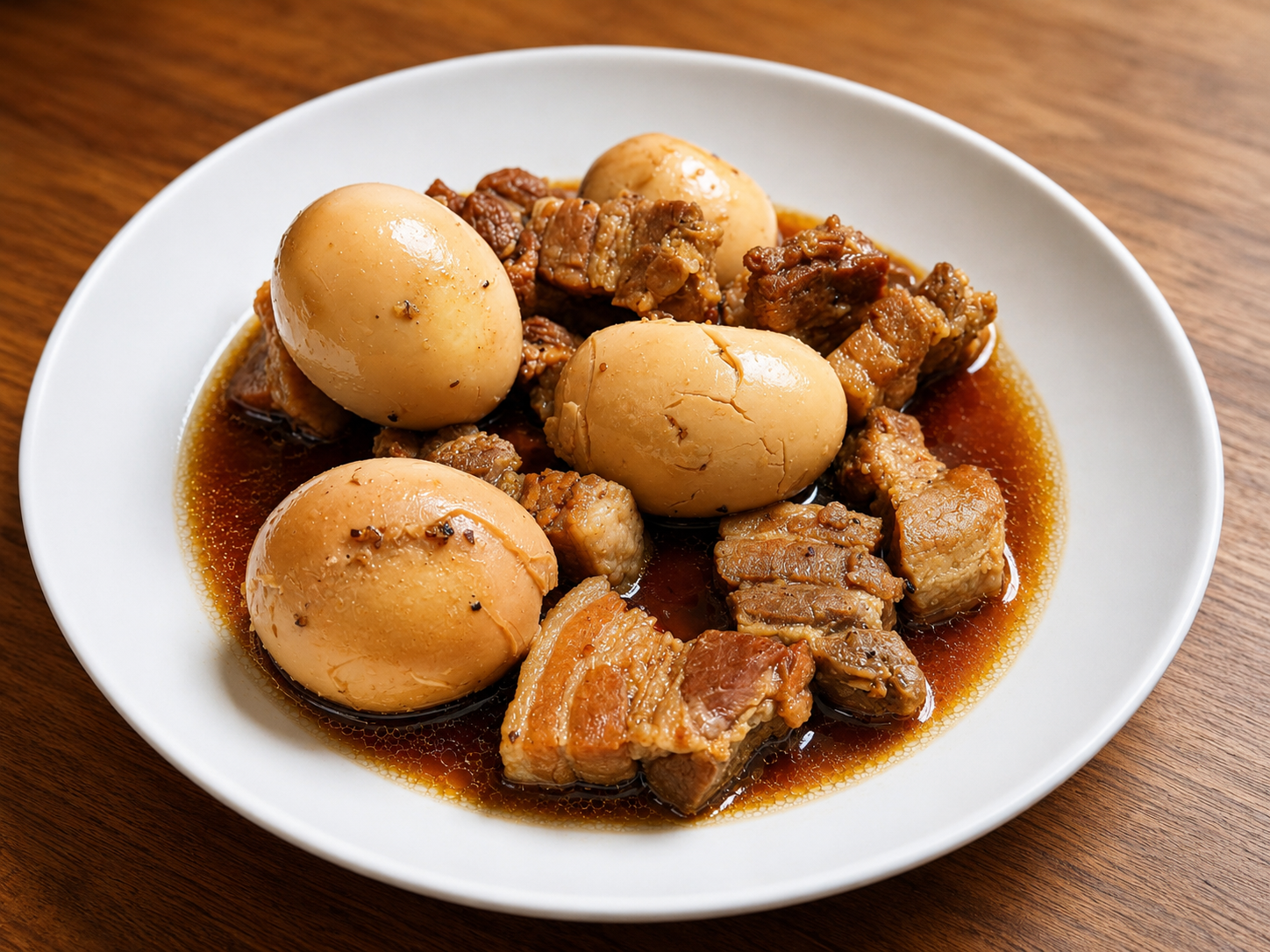
Easy Vietnamese Braised Pork and Eggs with Caramel Sauce
⏳ Marinating time: 30 minutes
🔥 Cooking time: About 50–60 minutes
🕒 Total time: About 80–90 minutes
🍽 Servings: 2–3
⭐ Difficulty: Easy
Thịt kho trứng, or Vietnamese braised pork and eggs, is one of the dishes I often think of when I want something simple and savory to serve with freshly cooked rice.
This recipe uses ingredients that are relatively easy to find in Japan: pork belly, eggs, fish sauce, and a few basic seasonings. The pork and eggs are slowly braised over low heat in fish sauce and homemade caramel sauce until the pork becomes tender and the sauce naturally reduces.
This is a recipe I cooked and adjusted based on my own experience. The finished dish has a deep savory flavor, a gentle hint of heat, and goes especially well with freshly cooked rice.
Ingredients
Main ingredients
- 500 g pork belly
- In Japan, look for pork belly sold as 豚バラブロック(ぶたバラブロック).
- Choose a piece with a relatively balanced ratio of lean meat to fat.
- 4 eggs
- 2 cloves garlic, finely chopped
- 2 dried chilies, halved and deseeded
- You can replace them with 1–2 fresh chilies, depending on your preference.
- Omit the chilies if you do not eat spicy food.
Seasonings
- 3 tablespoons fish sauce
- In the version I cooked, I used all 3 tablespoons to marinate the pork. This creates a fairly strong flavor that pairs well with freshly cooked rice.
- For easier seasoning control, you can use 2 tablespoons in the marinade and save the remaining tablespoon for the braising stage.
- If your family prefers lighter seasoning or you are cooking for children, reduce the total amount to 2 tablespoons.
- 1 tablespoon sugar
- Use 1 teaspoon for marinating the pork and the remaining 2 teaspoons for making the caramel.
- 1 teaspoon cooking oil
- 350 ml water
- About 50 ml hot water, only if the braising liquid reduces too quickly
- Black pepper, to taste
Fish sauce is the key seasoning that gives this dish its distinctive Vietnamese flavor. If you do not already have Vietnamese fish sauce, you can order the one I usually use from Amazon: https://amzn.to/4qyfxIe.
Instructions
Step 1: Prepare and marinate the pork
Rinse the pork belly, pat it dry, and cut it into pieces approximately 3–4 cm wide.
Marinate the pork with:
- 3 tablespoons fish sauce
- 1 teaspoon sugar
- Chopped garlic
- A little black pepper
Mix well and leave the pork to marinate for about 30 minutes.
This is the amount of fish sauce I used when testing the recipe, so the pork had a fairly strong flavor. If you prefer to divide the seasoning, use only 2 tablespoons of fish sauce in the marinade and save the remaining tablespoon for the braising stage.
Step 2: Boil the eggs while the pork is marinating
While the pork is marinating, boil the four eggs for about 8–10 minutes, until fully cooked.
Transfer them to cold water, peel, and set aside. By preparing the eggs during the marinating time, everything will be ready when you begin cooking the pork.
Step 3: Make the caramel
Add the following to a pot:
- The remaining 2 teaspoons sugar
- 1 teaspoon cooking oil
Heat over low heat until the sugar melts and turns a golden caramel-brown color.
Do not let the caramel become too dark, as it may taste bitter.
Step 4: Sear the pork
Add the marinated pork to the caramel.
Stir and cook for about 3–5 minutes, until the outside of the pork firms up slightly and is evenly coated with the caramel.
Step 5: Braise the pork and eggs
Using a toothpick, gently make a few small holes in each peeled boiled egg. This is the method I use to help the eggs come into better contact with the braising liquid while cooking.
Pour 350 ml water into the pot. If you used only 2 tablespoons of fish sauce in the marinade, add the remaining tablespoon at this stage.
The liquid should almost cover the pork, but the meat does not need to be completely submerged.
Add the eggs, black pepper, and prepared chilies. Bring the liquid to a boil. If foam appears on the surface, skim it off to keep the sauce clearer.
Reduce the heat to the lowest setting that still maintains a gentle simmer. Braise the pork and eggs uncovered. If you are using an IH cooktop, you can begin at level 2–3 and adjust as needed, depending on your stove.
Simmer slowly for about 40–45 minutes. During this time, the liquid will gradually evaporate and reduce, creating a richer and more concentrated sauce.
Occasionally turn the eggs gently so that all sides come into contact with the sauce and develop a more even color. There is no need to stir the pork frequently.
If the liquid reduces too quickly before the pork becomes tender, add about 50 ml hot water and continue braising over low heat.
Step 6: Taste and finish
When the pork is tender and the sauce has reduced to your preferred consistency, taste the dish before turning off the heat.
If you used all 3 tablespoons of fish sauce, you will probably not need any additional seasoning.
If you used only 2 tablespoons in total and the dish tastes too mild, add more fish sauce 1 teaspoon at a time. Stir gently and taste again before adding more.
Turn off the heat. If you like, finish the dish with a little more black pepper or some chopped green onion.
My notes after cooking
Date cooked: August 18, 2026
For this test, I used 500 g pork belly, four eggs, 3 tablespoons fish sauce, and two dried chilies that had been halved and deseeded. I did not use seasoning powder or soy sauce, keeping the Vietnamese flavor base simple with fish sauce, sugar, black pepper, and a little chili.
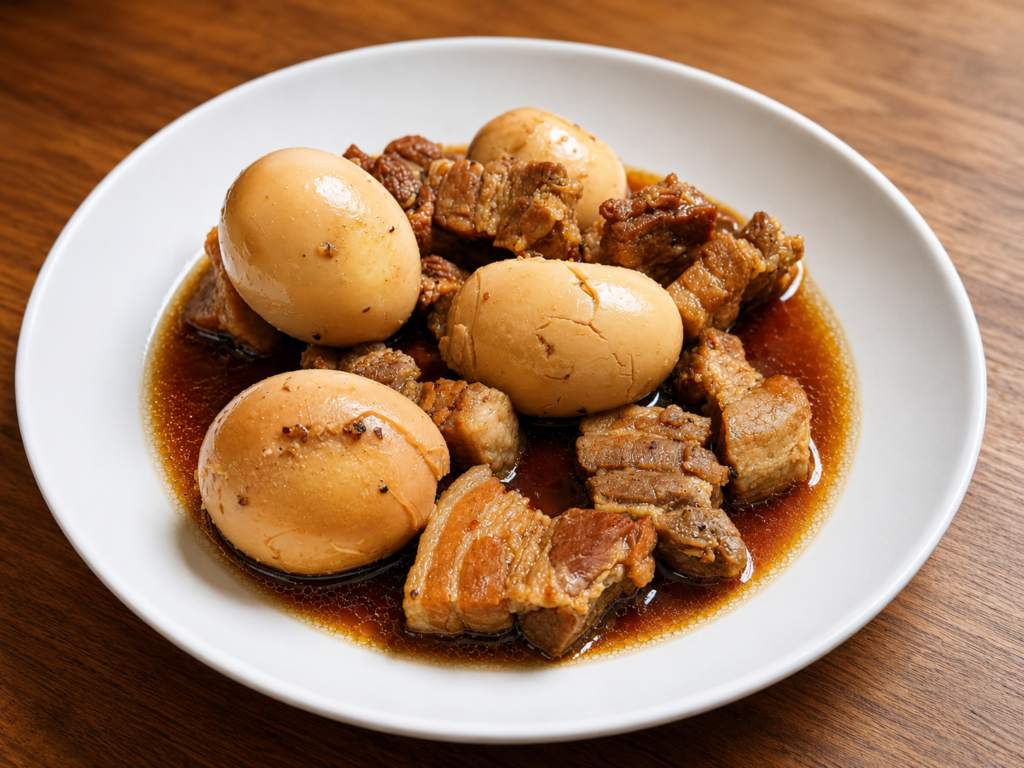
After simmering for about 40–45 minutes over low heat, the pork became tender and flavorful, while the braising liquid reduced into a rich sauce. The eggs developed a relatively even color and absorbed the flavor of the sauce. The two deseeded dried chilies added only a mild heat and did not make the dish overly spicy.
Because I marinated the pork for 30 minutes using all 3 tablespoons of fish sauce, the result was quite strongly seasoned. It may taste slightly salty to people who prefer lighter food, but it pairs very well with freshly cooked rice.
For a milder version, I recommend reducing the total amount of fish sauce to 2 tablespoons, then tasting the dish again near the end of the braising time.

