Gusto and the Cat Robot: What Is an Affordable Family Meal in Japan Really Like?
The first time I ate at Gusto in Toyooka, the thing I remembered most wasn’t the food. It was a four-shelf trolley-style robot with a cat-face display on top rolling right up to our table with our meals.
Its design is actually quite simple. The top is basically a large screen displaying a cat’s face, with blinking eyes and a few digital expressions. The body is divided into several shelves where dishes can be placed.
When an order is ready, the little cat leaves the kitchen area, navigates its way to the correct table, plays a cheerful sound, and stops so that customers can take their food. Once everything has been removed from the trays, it heads back to the kitchen and gets ready for its next delivery.
These days, I’m pretty used to seeing it. But the first time, I was genuinely surprised.
Before moving to Japan, even when I was living in Ho Chi Minh City, I had never experienced a restaurant where a robot would come all the way to the table to deliver the food.
What made it even more interesting was that I didn’t encounter this for the first time in Tokyo or Osaka, or in some futuristic, high-tech restaurant. It was at Gusto — a fairly affordable family restaurant chain — right here in Toyooka, the small city where I live.
If you enjoyed this small glimpse into everyday life in Toyooka, you might like following more of my Japan life and travel stories here: https://beanjp.com/en/blog/categories/japan-life-travel/ — I’ll keep adding new posts from around Japan, so feel free to drop by anytime and continue the journey with me.
An Affordable Family Meal in Japan
To understand Gusto, I think it first helps to see it for what it is: a family restaurant.
This isn’t the kind of place people usually visit for one particular dish or a memorable dining experience.
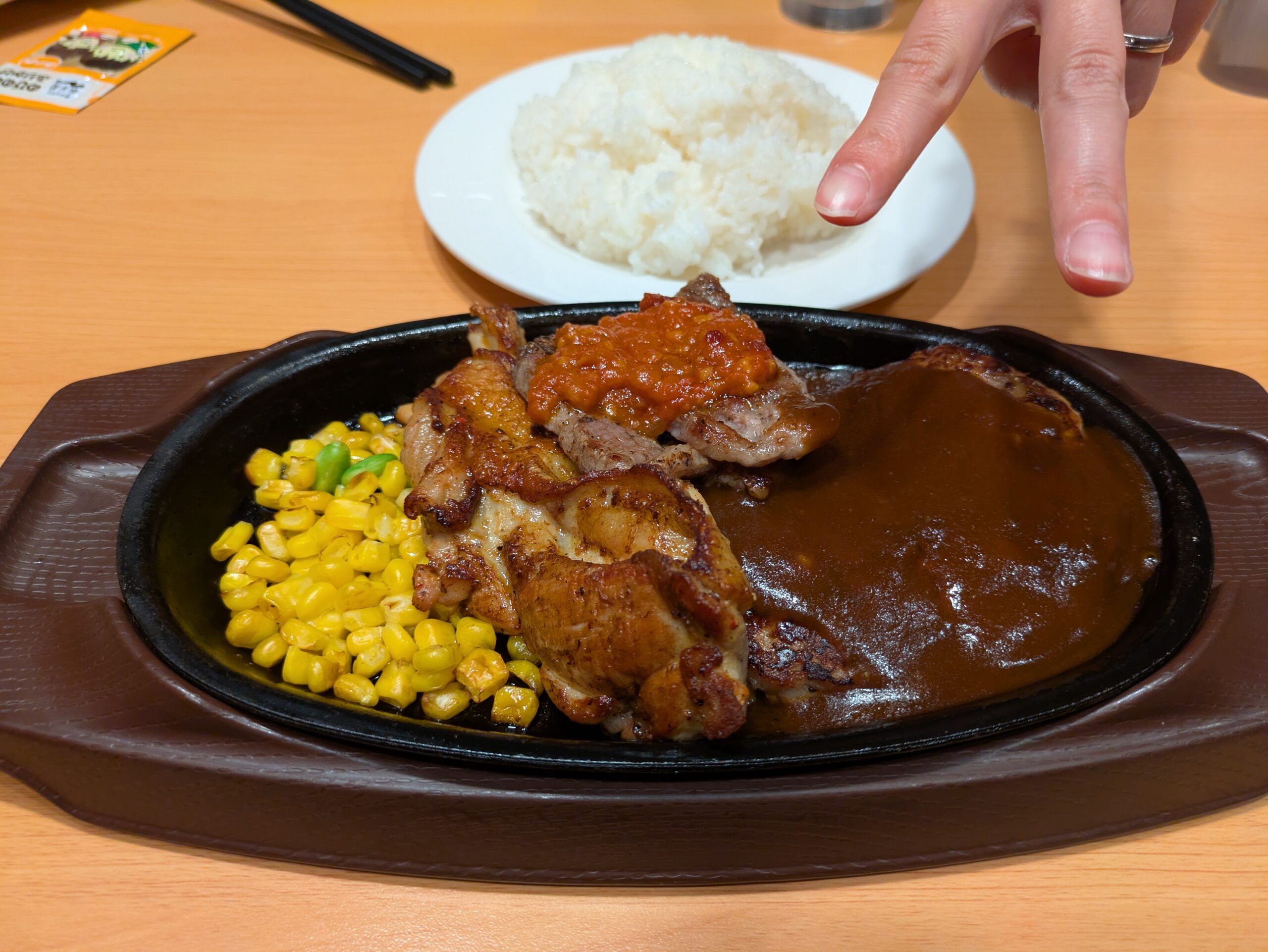
The menu is huge: hamburger steaks, pasta, pizza, fried food, Japanese-style set meals, desserts… There is usually something for almost everyone in the family.
The prices are also quite reasonable.
Most main dishes at Gusto are around ¥600–¥1,200, roughly 100,000–200,000 VND. Lunch sets can be around ¥700–¥1,000, or about 120,000–170,000 VND. So for a larger family that wants to eat out without spending too much, Gusto can be a pretty practical option.
Compared with average income levels in Japan, a meal at this price is often roughly equivalent to about one hour of work for someone earning a typical hourly wage. In other words, working for around an hour can pay for a meal at Gusto.
Looking at it this way makes it a little easier to understand the cost of living here and what an “affordable” family meal in Japan actually means.
As for the food itself, my personal feeling is that it’s not bad, but it’s also not the kind of food I find myself thinking about afterwards. Most dishes are easy to eat and the flavor is consistent, although I tend to get tired of it quite quickly, especially because there are plenty of fried and fairly oily choices.
The taste also feels very standardized. Sometimes I jokingly feel as if the food itself was cooked by a robot — everything is predictable, and you more or less know what you’re going to get.
But when I think about it differently, perhaps that’s exactly what a family restaurant needs to be.
Families with young children aren’t necessarily looking for a special culinary experience every time they go out. Sometimes all they need is somewhere clean and air-conditioned, with comfortable seating, plenty of choices for everyone, reasonable prices, quick service, and food that arrives without too much waiting.
Compared with the idea of “eating somewhere affordable” that I grew up with in Vietnam, it feels quite different.
In Vietnam, I would normally think of a small rice shop, a local restaurant, or a very simple place to eat.
In Japan, an affordable family meal can take place inside a large restaurant chain, with a tablet for ordering and robots moving between the tables.
The price is ordinary. The system behind it is surprisingly modern.
The Kid Loves the Cat, and the Parents Say Yes
There is one thing at Gusto that my son remembers much more clearly than the food: the cat robot.
When he was around three or four years old, every time we went there, he would immediately notice whenever the cat started approaching from a distance.
Sometimes he would talk to it, stand there watching its blinking face, and get excited about taking the dishes off the trays himself.
For an adult, it might simply be a machine transporting food. But for a three- or four-year-old child, it’s something completely different. It feels more like a little character moving around the restaurant.
Later, when I started reading more about Gusto, I found that Skylark Holdings — the company behind the brand — had also noticed that the robots created a sense of fun for customers, especially children.
Seen from that perspective, making the robot look like a cat probably wasn’t just a cute design choice.
If its only job was to transport food, they could easily have built a simple autonomous cart with several shelves. But once the machine has a face, blinking eyes, sounds and a little bit of “personality,” it becomes part of the dining experience.
And for a family restaurant, that matters.
A child probably doesn’t care whether today’s hamburger steak tastes slightly better or worse than the one they had last time. But they remember the cat.
And the next time the family asks, “Where should we go for dinner?”, they may simply want to go back to the place with the robot.
If the kid is happy, it’s pretty easy for the parents to say yes.
Behind the Cat Is a Different Way of Running a Restaurant
At some point, what made me curious about Gusto was no longer just the robot itself.
Once I started paying more attention, I realized that almost the entire ordering and serving process had been redesigned.
There are still paper menus on the tables, but most people seem to use the tablets.
Choose your food. Confirm the order. Send it.
A little later, the robot arrives with the dishes. Customers take the food themselves. Then the robot heads back toward the kitchen.
Staff no longer have to constantly walk back and forth from the kitchen to every table just to carry dishes in the traditional way.
It reminds me of other restaurant chains I’ve visited in Japan, such as Sushiro.
The common point isn’t simply that they have introduced a new piece of technology. The whole process has been changed so that technology can become part of the operation.
If a restaurant kept exactly the same operating model and simply placed a robot in the middle of it, I’m not sure the robot would actually help very much.
At Gusto, the tablets, robots and human staff seem to have been given different roles within the same process.
That was when I started to see the story as something more than just a cute robot.
It’s actually a very visible example of digital transformation happening inside an extremely ordinary part of everyday life.
A Transformation That Reached Even Toyooka
Skylark began introducing serving robots into its restaurants in August 2021.
By the end of 2022, the group had deployed around 3,000 robots across approximately 2,100 restaurants. Gusto alone had more than 1,200 locations using them.
What caught my attention wasn’t really the number 3,000. It was the speed and scale of the rollout.
In just over a year, a new way of serving customers had appeared in thousands of restaurants. Not only in Tokyo. Not only in Osaka. But in Toyooka too.
The robots weren’t introduced purely to make dining more entertaining either.
According to figures previously released by Skylark, using the robots significantly reduced the distance employees had to walk inside the restaurants and also shortened some of the time needed for clearing tables.
Put simply, the robots take over part of the repetitive work.
The staff are still there. They just don’t necessarily have to carry every single dish from the kitchen to customers’ tables dozens of times during each shift.
Seen this way, the cat robot is both part of the customer experience and an operational tool.
And perhaps that’s also why automation in Japan’s service industry is becoming increasingly interesting to watch.
In a country facing a serious labor shortage, using robots doesn’t necessarily mean completely replacing people. Sometimes it simply means letting machines handle repetitive tasks so that people don’t have to keep doing the same things over and over again every day.
Something I Find Interesting About Living in Japan
After living in Japan for a while, I’ve noticed an interesting contrast.
There are times when digital transformation here feels surprisingly slow. There are still paper-based procedures, old ways of doing things, and systems that have been around for many years.
And yet, in the same country, I can walk into an affordable family restaurant in a small city like Toyooka, order dinner from a tablet, and wait for a cat robot to bring the food to my table.
Perhaps the question isn’t simply whether Japan is fast or slow when it comes to digital transformation.
Maybe some technologies, once they find the right place within an existing operating system, can become part of everyday life very naturally. So naturally, in fact, that after a while people living here barely notice them anymore.
I’m the same.
These days, when I go to Gusto and see the cat robot passing by, it feels completely normal. But when I think back to the first time I saw it, I still remember being a little surprised.
An affordable restaurant chain. A small city. A family going out for dinner like any other family. My son sitting there waiting for the food. And from somewhere near the kitchen, a little cat robot slowly making its way toward our table.
Sometimes, one small detail from everyday life in Japan is enough to make me curious about the much bigger system quietly operating behind it.
If you’re interested in life in Japan, I also share a lot more on my YouTube channel—everything from daily experiences living here, personal stories, to travel moments around Japan. Feel free to check it out and subscribe if you enjoy Japan-related content: https://www.youtube.com/@beanjp