The First Time My Son Walked to School on His Own in Japan
One of the things that has always impressed me about living in Japan is seeing elementary school children walking to school every morning.
In Vietnam, especially in large cities, it is quite rare to see first graders going to school on their own. In Japan, however, it is simply part of everyday life. It was only when my son started first grade that I truly began to understand this aspect of Japanese culture.
A New Chapter Begins
In Japan, entering first grade — ichinensei (一年生) — feels like an important milestone in a child’s life.
When children are in kindergarten, parents usually take them to school in the morning and pick them up in the afternoon. Once elementary school begins, things gradually change. They wake up on their own, get dressed, prepare their school bag, and head to the neighborhood meeting point at the designated time to walk to school with other children.
I still remember my son’s first day of school.
That morning, our whole family was busy making sure everything was ready. Since it was his first day, we kept worrying that we might forget something. A jacket, a hand towel, a water bottle, a hat, notebooks… we checked everything several times before finally feeling ready.
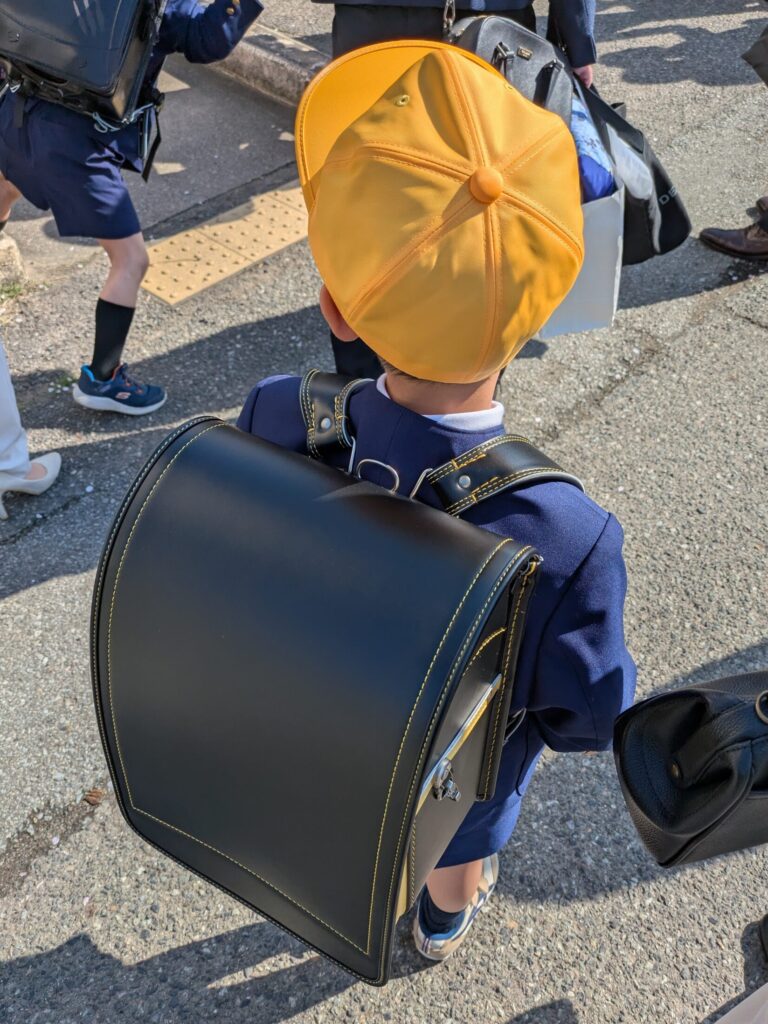
He seemed a little shy and unsure of himself that morning. But once he put on his randoseru — the traditional school backpack used by almost every elementary school student in Japan — and walked out to the small park in front of our house where the children gather each morning, things started to feel more natural.
When we arrived, he greeted the others and quietly stood in line. He recognized a few friends from kindergarten, but they mostly smiled at each other and stood together without saying much. Seeing him a little reserved didn’t surprise me. He has always needed a bit of time to adjust to new environments. I remember thinking that in a few days, once he got used to walking to school with the other children, everything would probably feel normal.
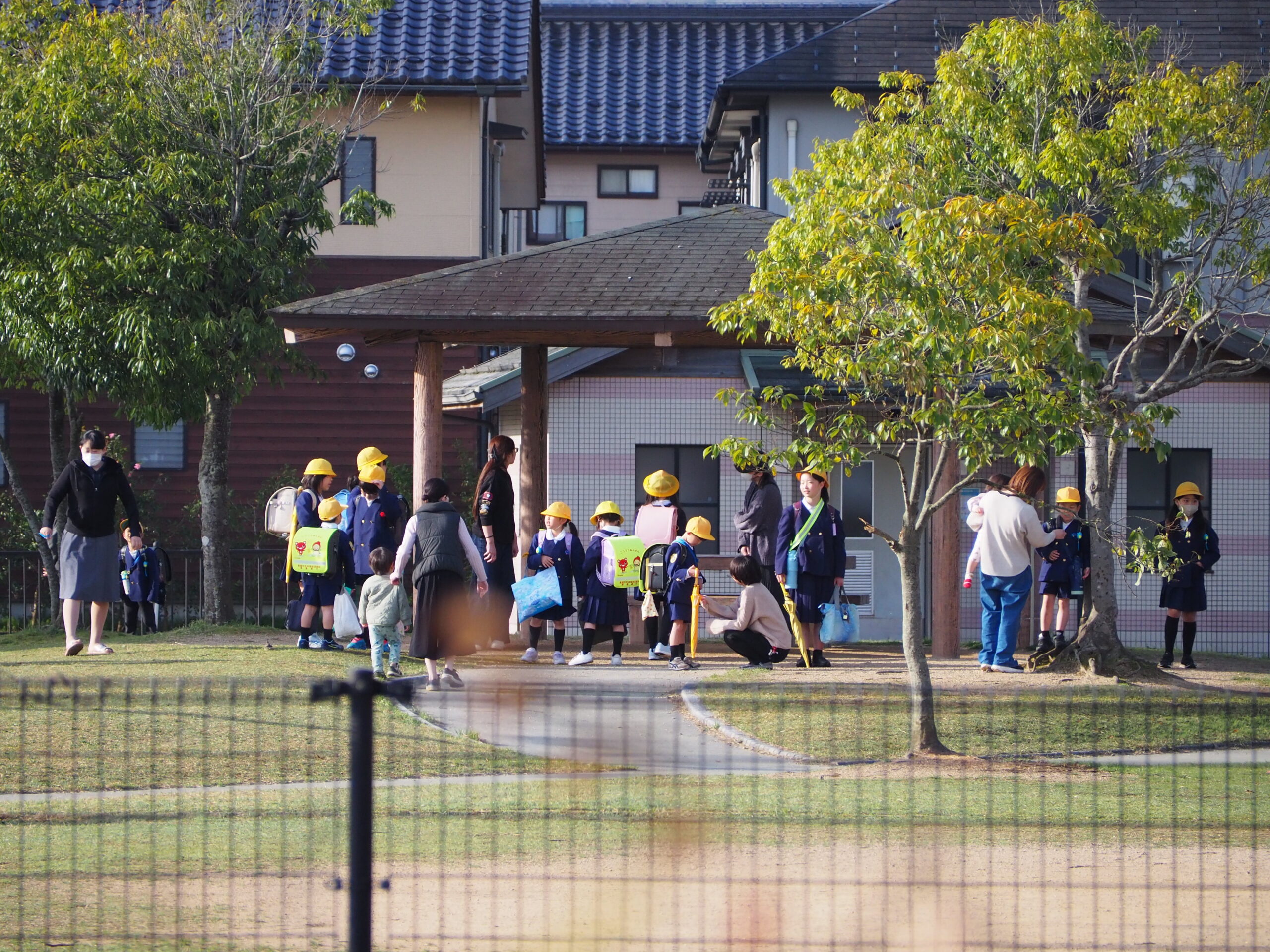
Right on schedule, the group formed two lines and started walking toward school.
I followed them for a short distance before stopping and watching from behind. A line of small children carrying their randoseru backpacks slowly disappeared down the road toward the school.
At that moment, I thought, “He’ll be fine.”
And for the first time, I felt that my son was stepping into a new stage of life — becoming a little more independent, little by little.
Independence Doesn’t Happen by Accident
When people see Japanese elementary school children walking to school by themselves, the first reaction is often:
“Japan must be really safe.”
And objectively speaking, it is relatively safe for children.
But after living here, I’ve realized that this sense of safety doesn’t simply happen on its own. It exists because schools, parents, local governments, and communities all play a role in creating it.
One thing I notice clearly is what I would describe as a “safe corridor” for children. The routes students use to get to school are carefully organized and supported to make walking as safe as possible.
During school commuting hours, volunteers often stand at major intersections. They carry flags, wear armbands or identification badges, and help children cross the street safely.
Along these routes, you’ll also see signs and road markings reminding drivers to slow down and pay attention because children may be crossing.
Schools and families also spend a lot of time teaching children how to walk safely. They learn how to watch traffic signals, look both ways before crossing, stay with the group, and avoid running into the street.
There is one detail that particularly stands out to me.
When crossing the road, many children raise one hand high in the air to signal that they are about to cross. Cars stop, the children cross safely, and many of them bow or say thank you afterward.
The first time I saw this, I was genuinely surprised.
The longer I live in Japan, the more I feel that walking to school is about much more than simply getting from home to the classroom.
It is part of how children learn independence.
They learn to prepare their own things, manage their time, travel with a group, remember routes, and handle small situations on their own.
Independence is not something that suddenly appears one day. It is built through small habits repeated every day.
And perhaps it is not only children who are learning. Parents are learning to let go, little by little, as well.
And Then Parents Learn to Let Go
The same pattern continues after school.
Children walk home, take a school bus, or, if both parents are working, spend time at gakudo (学童), an after-school childcare program where they can stay until their parents finish work.
Years ago, many Japanese families followed a different lifestyle. Fathers often worked while mothers stayed at home, so children usually returned directly home after school. Several decades ago, some families even felt comfortable allowing children to stay home alone for a while because society was generally considered very safe.
Today, things are different.
Even in Japan, many parents are no longer comfortable leaving young children at home by themselves. As a result, gakudo programs have become increasingly common in elementary schools across the country.
To me, this is also a reminder that Japanese society continues to change. Not everything remains the same from one generation to the next.
In Vietnam, children in rural areas or small towns may still walk to school on their own. In large cities, however, the situation is very different. Most parents need to arrange transportation themselves or rely on grandparents and relatives to help.
Part of the reason is traffic. Part of it is the sheer number of vehicles on the road. And part of it is the feeling that it may not be safe enough for young children to travel independently.
Infrastructure also plays an important role. In Japan, routes to school are generally designed with children in mind. In many Vietnamese cities, sidewalks and pedestrian spaces are often less friendly for young children. As a result, seeing elementary school students walk to school on their own has become much less common than it once was.
Thinking about this reminds me of my own childhood.
When I was in elementary school, I walked to school every day. Traffic was lighter back then, and there were far fewer people around. The walk from home to school took about ten or fifteen minutes, and nobody drove me there.
If a friend happened to live nearby, I would stop by their house and ask them to come along. Otherwise, I simply walked by myself. There were no organized groups like the ones I see in Japan today.
My parents were busy working, and my grandparents had their own responsibilities. Preparing for school each morning was something most children handled on their own. Looking back now, I think children of my generation in Vietnam were quite independent in many ways.
Perhaps that’s why, whenever I see groups of elementary school children walking to school in Japan, I sometimes catch a glimpse of my own childhood.
The circumstances may be different. The systems may be different. But the mixture of excitement and nervousness that comes with taking those first small steps toward independence feels surprisingly familiar.
My son has now settled into the routine. The hesitant look he had during those first few days is mostly gone.
It has only been a little over a month, but when I look back, I can already see how much he has changed since his first day of elementary school.
Perhaps what impresses me most is not the sight of children walking to school on their own, nor even the carefully designed systems that make it possible.
What stays with me is how Japanese society encourages children to become independent through small everyday experiences, and how parents learn to step back and allow their children to grow through those experiences.
Walking to school in Japan is not simply a way for children to learn independence.
Sometimes, it is also a way for parents to realize that their children are growing up, one small step at a time.
— Bean JP
Toyooka, Hyogo, Japan